CHINESE
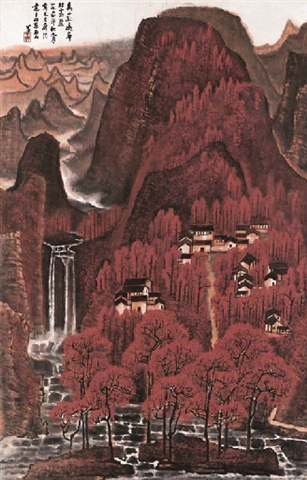
Chinese art is visual art that, whether ancient or modern, originated in or is practiced in China or by Chinese artists or performers. Early so-called "stone age art" dates back to 10,000 BC, mostly consisting of simple pottery and sculptures. This early period was followed by a series of art dynasties, most of which lasted several hundred years.


With the end of the last dynasty in China, the New Culture Movement began and defied all facets of traditionalism.

If the art was presented in a manner that favored the government, the artists were heavily promoted.
Artists were encouraged to employ socialist realism. Some Soviet Union socialist realism was imported without modification, and painters were assigned subjects and expected to mass-produce paintings.
Contemporary Chinese art (中国当代艺术, Zhongguo Dangdai Yishu) often referred to as Chinese avant-garde art.
 Beginning in the late 1980s there was unprecedented exposure for younger Chinese visual artists in the west to some degree through the agency of curators based outside the country such as Hou Hanru.
Other art works produced in China or Hong Kong were sold in places such as Christie's including a Chinese porcelain piece with the mark of Emperor Qianlong sold for HKD $ $151.3 million.

AFRICA


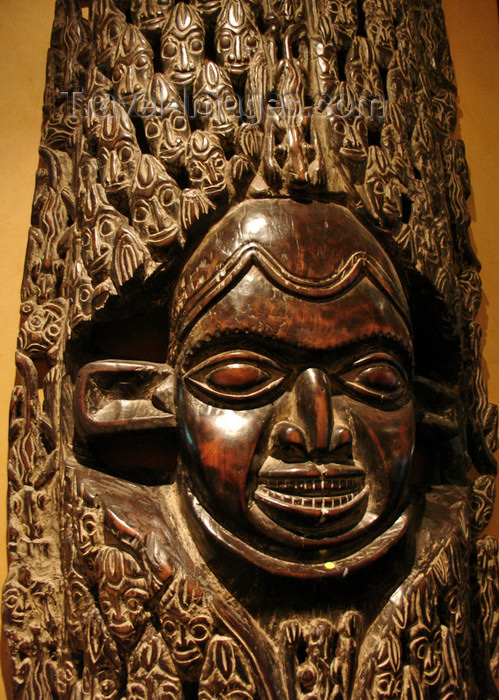
Emphasis on the human figure: The human figure has always been the primary subject matter for most African art, and this emphasis even influenced certain European traditions.
Visual abstraction: African artworks tend to favor visual abstraction over naturalistic representation. This is because many African artworks generalize stylistic norms.
Emphasis on sculpture: African artists tend to favor three-dimensional artworks over two-dimensional works. Even many African paintings or cloth works were meant to be experienced three-dimensionally.
Emphasis on performance art: An extension of the utilitarianism and three-dimensionality of traditional African art is the fact that much of it is crafted for use in performance contexts, rather than in static ones. For example, masks and costumes very often are used in communal, ceremonial contexts, where they are "danced."
Nonlinear scaling: Often a small part of an African design will look similar to a larger part, such as the diamonds at different scales in the Kasai pattern at right. Louis Senghor, Senegal’s first president, referred to this as "dynamic symmetry."


No hay comentarios:
Publicar un comentario