sábado, 19 de marzo de 2011

ROCOCO

Also referred to as "Late Baroque" is an 18th century style which developed as Baroque artists gave up their symmetry and became increasingly ornate, florid, and playful. Rococo rooms were designed as total works of art with elegant and ornate furniture, small sculptures, ornamental mirrors, and tapestry complementing architecture, reliefs, and wall paintings. The word Rococo is seen as a combination of the French rocaille, meaning stone, and coquilles, meaning shell, due to reliance on these objects as motifs of decoration.


Furniture and decorative objects

The lighthearted themes and intricate designs of Rococo presented themselves best at a smaller scale than the imposing Baroque architecture and sculpture. It is not surprising, then, that French Rococo art was at home indoors. Metalwork, porcelain figures,frills and especially furniture rose to new pre-eminence as the French upper classes sought to outfit their homes in the now fashionable style.
During the Rococo period, furniture was lighthearted, physically and visually.


Interior design

Solitude Palace in Stuttgart and Chinese Palace in Oranienbaum, the Bavarian church of Wies and Sanssouci in Potsdam are examples of how Rococo made its way into European architecture. A few anti-architectural hints rapidly evolved into full-blown Rococo at the end of the 1720s and began to affect interiors and decorative arts throughout Europe. The richest forms of German Rococo are in Catholic Germany.


Painting


Though Rococo originated in the purely decorative arts, the style showed clearly in painting. These painters used delicate colors and curving forms, decorating their canvases with cherubs and myths of love. Some works show a sort of naughtiness or impurity in the behavior of their subjects, showing the historical trend of departing away from the Baroque's church/state orientation.


jueves, 17 de marzo de 2011

Neoclassicism

Neoclassicism is the name given to quite distinct movements in the decorative and visual arts, literature, theatre, music, and architecture that draw upon Western classical art and culture (usually that of Ancient Greece or Ancient Rome). These movements were dominant in northern Europe during the mid-18th to the end of the 19th century.

In the visual arts the European movement called "neoclassicism" began after A.D. 1765, as a reaction against both the surviving Baroque and Rococo styles, and as a desire to return to the perceived "purity" of the arts of Rome, the more vague perception ("ideal") of Ancient Greek arts, and, to a lesser extent, 16th century Renaissance Classicism.
Contrasting with the Baroque and the Rococo, Neo-classical paintings are devoid of pastel colors and haziness; instead, they have sharp colors with Chiaroscuro. In the case of Neo-classicism in France, a prime example is Jacques Louis David whose paintings often use Roman and Greek elements to extol the French Revolution's virtues (state before family).
At first, classicizing decor was grafted onto familiar European forms, as in the interiors for Catherine II's lover Count Orlov, designed by an Italian architect with a team of Italianstuccadori: only the isolated oval medallions like cameos and the bas-relief overdoors hint of neoclassicism; the furnishings are fully Italian Rococo.

In the decorative arts, neoclassicism is exemplified in Empire furniture made in Paris, London, New York, Berlin; in Biedermeier furniture made in Austria; in Karl Friedrich Schinkel's museums in Berlin, Sir John Soane's Bank of England in London and the newly built "capitol" in Washington, DC; and in Wedgwood's bas reliefs and "black basaltes" vases. 


In American architecture, neoclassicism was one expression of the American Renaissance movement, ca 1890–1917; its last manifestation was in Beaux-Arts architecture, and its very last, large public projects were the Lincoln Memorial (highly criticized at the time), The National Gallery in Washington, DC (also heavily criticized by the architectural community as being backward thinking and old fashioned in its design), and the American Museum of Natural History's Roosevelt Memorial. These were white elephants when they were built. In the British Raj, Sir Edwin Lutyens' monumental city planning for New Delhi marks the glorious sunset of neoclassicism. World War II was to shatter most longing for – and imitation of – mythical, heroic times.


BAROQUE

Is an artistic style prevalent from the late 16th century to the early 18th century in Europe. It is most often defined as "the dominant style of art in Europe between the Mannerist and Rococo eras, a style characterized by dynamic movement, overt emotion and self-confident rhetoric.
Beginning around the year 1600, the demands for new art resulted in what is now known as the Baroque. The canon promulgated at the Council of Trent(1545–63) with which the Roman Catholic Church addressed the representational arts, rooted in the Protestant Reformation.
There were highly diverse strands of Italian baroque painting, from Caravaggio to Cortona; both approaching emotive dynamism with different styles. Another frequently cited work of Baroque art is Bernini's Saint Theresa in Ecstasy for the Cornaro chapel in Saint Maria della Vittoria, which brings together architecture, sculpture, and theatre into one grand conceit.


In Baroque sculpture, groups of figures assumed new importance, and there was a dynamic movement and energy of human forms— they spiraled around an empty central vortex, or reached outwards into the surrounding space. For the first time, Baroque sculpture often had multiple ideal viewing angles. The characteristic Baroque sculpture added extra-sculptural elements.


Baroque architecture was taken up with enthusiasm in central Germany many examples of Baroque architecture and town planning are found in other European towns, and in Latin America. Town planning of this period featured radiating avenues intersecting in squares, which took cues from Baroque garden plans. In Sicily, Baroque developed new shapes and themes as in Noto, Ragusa and Acireale"Basilica di San Sebastiano".
 
In theatre, the elaborate conceits, multiplicity of plot turns, and variety of situations characteristic of Mannerism (Shakespeare's tragedies, for instance) were superseded by opera, which drew together all the arts into a unified whole.
The term Baroque is also used to designate the style of music composed during a period that overlaps with that of Baroque art, but usually encompasses a slightly later period. J.S. Bach, G.F. Handel and Antonio Vivaldi are often considered its culminating figures.

miércoles, 16 de marzo de 2011

Chinese & African


CHINESE 


Chinese art is visual art that, whether ancient or modern, originated in or is practiced in China or by Chinese artists or performers. Early so-called "stone age art" dates back to 10,000 BC, mostly consisting of simple pottery and sculptures. This early period was followed by a series of art dynasties, most of which lasted several hundred years. 


With the end of the last dynasty in China, the New Culture Movement began and defied all facets of traditionalism. 
Following was the Second Sino-Japanese War in particular the Battle of Shanghai would leave the major cultural art center borderline to a humanitarian crisis.


If the art was presented in a manner that favored the government, the artists were heavily promoted.
Artists were encouraged to employ socialist realism. Some Soviet Union socialist realism was imported without modification, and painters were assigned subjects and expected to mass-produce paintings. 


Contemporary Chinese art (中国当代艺术, Zhongguo Dangdai Yishu) often referred to as Chinese avant-garde art.
Beginning in the late 1980s there was unprecedented exposure for younger Chinese visual artists in the west to some degree through the agency of curators based outside the country such as Hou Hanru.


Other art works produced in China or Hong Kong were sold in places such as Christie's including a Chinese porcelain piece with the mark of Emperor Qianlong sold for HKD $ $151.3 million. 


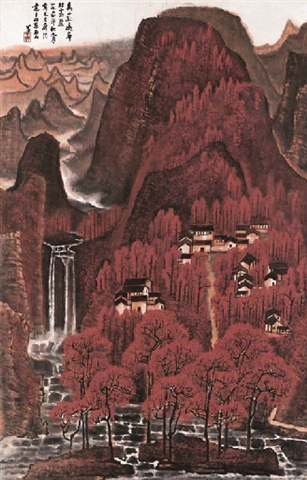
A 1964 painting "All the Mountains Blanketed in Red" was sold for HKD $35 million.


 Auctions were also held at Sotheby's where Xu Beihong's 1939 masterpiece "Put Down Your Whip" sold for HKD $72 million.


AFRICA


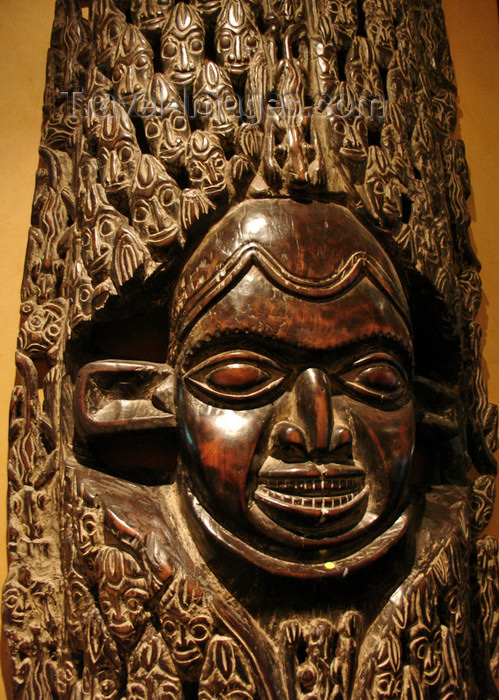
African art constitutes one of the most diverse legacies on earth. Though many casual observers tend to generalize "traditional" African art, the continent is full of people, societies, and civilizations, each with a unique visual special culture. The definition also includes the art of the African Diasporas, such as the art of African Americans. Despite this diversity, there are some unifying artistic themes when considering the totality of the visual culture from the continent of Africa.


Emphasis on the human figure: The human figure has always been the primary subject matter for most African art, and this emphasis even influenced certain European traditions.
Visual abstraction: African artworks tend to favor visual abstraction over naturalistic representation. This is because many African artworks generalize stylistic norms.
Emphasis on sculpture: African artists tend to favor three-dimensional artworks over two-dimensional works. Even many African paintings or cloth works were meant to be experienced three-dimensionally. 
Emphasis on performance art: An extension of the utilitarianism and three-dimensionality of traditional African art is the fact that much of it is crafted for use in performance contexts, rather than in static ones. For example, masks and costumes very often are used in communal, ceremonial contexts, where they are "danced."
Nonlinear scaling: Often a small part of an African design will look similar to a larger part, such as the diamonds at different scales in the Kasai pattern at right. Louis Senghor, Senegal’s first president, referred to this as "dynamic symmetry." 


Renaissance

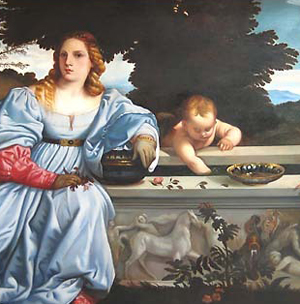
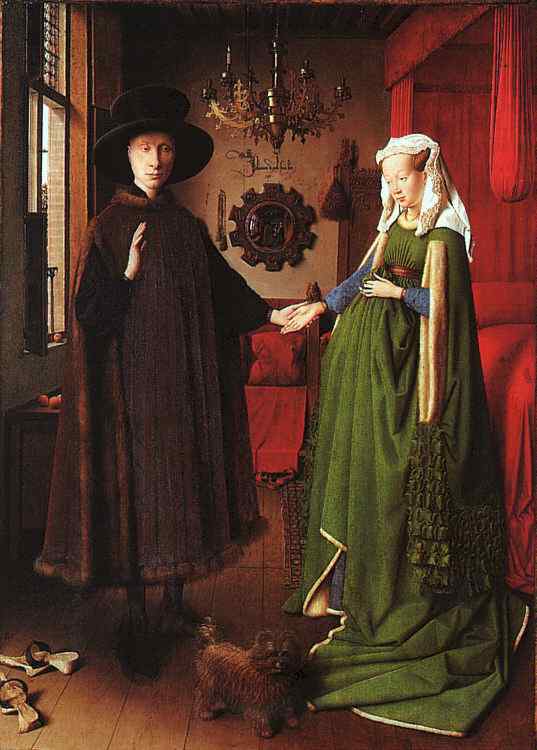
The Renaissance patrons wanted art that showed joy in human beauty and life’s pleasures. Renaissance art is more lifelike than in the art of the Middle Ages. 


Renaissance artists studied perspective, or the differences in the way things look when they are close to something or far away. The artists painted in a way that showed these differences.


An artist from Florence named Giotto was one of the first to paint in this new style. Giotto lived more than a century before the beginning of the Renaissance, but his paintings show real emotion. The bodies look solid, and the background of his paintings shows perspective.


Leonardo da Vinci was born in 1452 in the village of Vinci. His name means Leonardo of Vinci. Leonardo began his career working for a master painter in Florence. 
He was a scientist and an inventor as well as an artist. He made notes and drawings of everything he saw. Leonardo invented clever machines, and even designed imitation wings that he hoped would let a person fly like a bird.


Michelangelo was a devout Christian, and the church was his greatest patron. 
He designed the dome of St. Peter’s church in Rome. Nearby, Michelangelo’s paintings cover the ceiling of the Sistine Chapel, the building where new popes have been selected for more than five hundred years.
Working alone, Michelangelo had to lie on his back atop high scaffolding while he painted the vast ceiling.