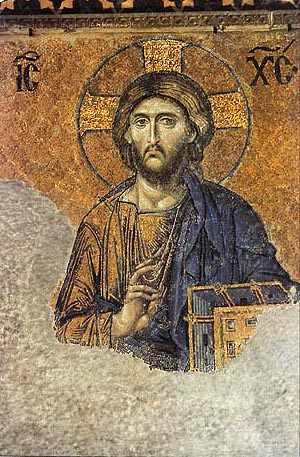

Just as the Byzantine empire represented the political continuation of the Roman Empire, Byzantine art developed out of the art of the Roman empire, which was itself profoundly influenced by ancient Greek art.
The Byzantine capital, Constantinople, was adorned with a large number of classical sculptures.
The most salient feature of this new aesthetic was its “abstract,” or anti-naturalistic character. If classical art was marked by the attempt to create representations that mimicked reality as closely as possible, Byzantine art seems to have abandoned this attempt in favor of a more symbolic approach.
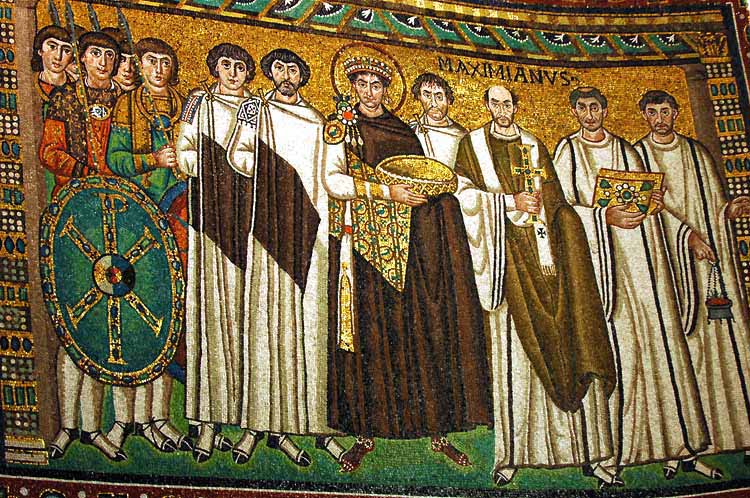
Byzantine emperors that decorated the interior of the sixth-century church of Hagia Sophia in Constantinople.
Religious art was not, however, limited to the monumental decoration of church interiors. One of the most important genres of Byzantine art was the icon, an image of Christ, the Virgin, or a saint, used as an object of veneration in Orthodox churches and private homes alike. Icons were more religious than aesthetic in nature.
Periods:
Early Byzantine art The most important surviving monument of this period is the obelisk and base erected by Theodosius in the Hippodrome.

The Age of Justinian A significant component of Justinian's project of imperial renovation was a massive building program, which was described in a book, the Buildings, written by Justinian's court historian, Procopius. Justinian renovated, rebuilt, or founded anew countless churches within Constantinople, including Hagia Sophia.

The seventh-century crisis The most significant surviving monumental projects of this period were undertaken outside of the imperial capital. The church of Hagios Demetrios in Thessaloniki was rebuilt after a fire in the mid-seventh century.

Iconoclasm While iconoclasm severely restricted the role of religious art, and led to the removal of some earlier apse mosaics and (possibly) the sporadic destruction of portable icons, it never constituted a total ban on the production of figural art.

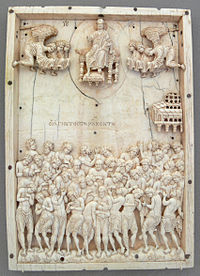
Macedonian Art saw a revival of the late antique technique of ivory carving. Many ornate ivory triptychs and diptychs survive, such as the Harbaville Triptych and a triptych at Luton Hoo, dating from the reign of Nicephorus Phocas).
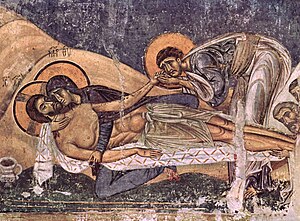
Comnenian Age The Komnenoi were great patrons of the arts, and with their support Byzantine artists continued to move in the direction of greater humanism and emotion, of which the Theotokos of Vladimir, the cycle of mosaics at Daphni, and the murals at Nerezi yield important examples.

Gothic art:
was a Medieval art movement that developed in France out of Romanesque art in the mid-12th century, led by the concurrent development of Gothic architecture.
he earliest Gothic art was monumental sculpture, on the walls of Cathedrals and abbeys. Christian art was often typological in nature , showing the stories of the New Testament and the Old Testament side by side.
Secular art came in to its own during this period with the rise of cities, foundation of universities, increase in trade, the establishment of a money-based economy and the creation of a bourgeois class who could afford to patronize the arts and commission works resulting in a proliferation of paintings and illuminated manuscripts.
Painting in a style that can be called "Gothic" did not appear until about 1200, or nearly 50 years after the start of Gothic architecture and sculpture. The transition from Romanesque to Gothic is very imprecise and not at all a clear break, and Gothic ornamental detailing is often introduced before much change is seen in the style of figures or compositions themselves.



No hay comentarios:
Publicar un comentario